
Gratitude, Embodied
Practices
for
giving
thanks.
Seven ways to practice gratitude with your whole body: write it, walk it, picture it, move it, send it, say it and hold it.
Each one is three steps, a few prompts, the research behind it and one rule. Six have a guided voice mode. None takes more than fifteen minutes. Two are open here. The other five are in the free library.All seven are open, with the seven-night journal and the letter composer.
Before you start: one slow breath in, a longer one out, and name one thing that went right today. That’s already a practice.
Seven feathers. Seven ways to say thanks.
Every tail feather is a practice. Pick one to see what it asks of you, what you’ll need and why it works.
Each bar is a dose that a study actually tested, measured in days from tonight. The findings are the studies’ own, with their limits on the research page.
how long the practice runs if you start tonightThanksgiving
Older than the research.
The oldest study on this page was published in 2005. The practice is closer to twenty-five hundred years old. Three old words for what you’re about to do.
Pali · the Buddha
Kataññu
Knowing what was done for you.
The Buddha named two kinds of people as hard to find in the world: the one who is first to do a kindness, and the one who is grateful for a kindness done. Gratitude here is a skill of attention. You have to notice the kindness before you can thank it.
Dullabhā Sutta, Aṅguttara Nikāya 2:118 (numbered 2:119 in some editions)
Sanskrit · Patanjali
Santosha
Contentment.
The second of the five niyamas, the personal observances in the Yoga Sutras. Patanjali gives it one line: from contentment, unsurpassed happiness is gained. Enough is treated as something you practice, the way you practice a pose.
Yoga Sutras 2.32 and 2.42
Latin · Cicero
Gratia
Thanks, favor, grace.
Defending a friend in a Roman court in 54 BC, Cicero told the jury there was nothing he would rather be than grateful. He called it the greatest virtue and the parent of all the others. The word behind gratitude is also the word behind grace.
Pro Plancio, 54 BC
The seven practices below are the same instruction, with a timer and a citation.
Gratitude, Embodied
Practices for Giving Thanks
Seven ways to practice gratitude with your whole body: write it, walk it, picture it, move it, send it, say it and hold it. Each one is three simple steps, a few prompts, and the research behind it.
Every practice here takes five to fifteen minutes and rests on peer-reviewed research. The rings breathe with you: four seconds in, four seconds out.
Three steps each
Read the steps once, then do them. Every practice is three moves you can remember without your phone.
The prompts give you words when your mind goes blank.
One rule
Each practice has one rule in the red box. If you only remember one thing, remember that.
Pick one practice for a week before you add another.
Go gently
Gratitude helps, and the honest research says the effect is real but modest. It's a companion to real support in a hard season, not a replacement for it.
Practice 1 of 7 · Journal
Three Good Things
You remember the one rude email. Not the five kind ones.
A five-minute bedtime journal that evens the score.
- The reframesay it to yourself
- You're not a negative person. You have a very good alarm system.
- You'll need
- A pen · five minutes
- The one rule
- Specific beats big.
Brains log threats in ink and good moments in pencil. Writing the good down, and why it happened, gives it a second pass.
The practice
- 1
Rewind the day
Lights low, notebook out. Scroll back from now to the moment you woke up, looking for anything that went well. Tiny counts.
- 2
Write three
Three things that went well today, specific enough to picture. Not “my family” but “my kid laughed at my terrible joke at dinner.”
- 3
Write the why
Next to each one, write why it happened. What did you do? Who showed up for you? That's where the gratitude lives.
What it looks like
One night. One page.
- 1.The sunrise turned the whole kitchen orange while I made coffee.WHY I got up ten minutes early and actually looked out the window.
- 2.A friend texted “thinking of you” on a day I really needed it.WHY She remembers what I'm going through. I'm lucky to have her.
- 3.I stayed calm when traffic made me late.WHY I did three slow exhales instead of leaning on the horn.
The why is where the gratitude lives: what you did, or who showed up for you.
Stuck? Try these
- What made me laugh today?
- Who made today easier, even a little?
- What went better than I expected?
One honest line beats three you don't mean.
Why it works
One week of writing, six months later
In a randomized online study, people who wrote down three good things and their causes every night for one week were happier and less depressed than a placebo group one, three and six months later. Those who kept going on their own did best. Larger reviews since then find the effect is real but small: it nudges your baseline. It doesn't cure anything.
Seligman, Steen, Park & Peterson, American Psychologist (2005) · Davis et al., Journal of Counseling Psychology (2016)
The one rule
Specific beats big.
“My health” every night turns into wallpaper. One moment you can actually picture does the work. If tonight it all feels forced, write one thing and go to sleep.
Come back to this tonight, right before bed.
Practice 2 of 7 · Move
The Savoring Walk
You walked past a hundred good things today.
A fifteen-minute walking meditation that turns noticing into gratitude.
- The reframesay it to yourself
- You're not ungrateful. You're in a hurry.
- You'll need
- Shoes · fifteen minutes
- The one rule
- Slow enough to notice.
Gratitude starts with noticing, and noticing needs a slower pace than most of us ever walk. This walk slows your feet so your attention can catch up.
The practice
- 1
Halve your pace
Phone on silent, in a pocket. For the first minute, walk at about half your usual speed and feel each heel land.
- 2
Hunt for good
Light through bare trees. Cold air in your lungs. A dog's whole-body wag. Each time something good catches you, think “thank you” and keep walking.
- 3
Stop for one
Pick one and stand still for three slow breaths. Take in its color, sound and smell as if you'll have to describe it later. Do this three times.
The walk · fifteen minutes
Slow down. Look for it. Stop for it.

Halve your pace
Phone away. Feel each heel land.

Hunt for good
Notice it. Think “thank you.”

Stop for one
Stand still. Three slow breaths.
Stop three times, then head home
What to look for
- Something beautiful I usually walk right past
- Something bigger than me: sky, trees, the long view
- A small kindness between strangers
Take a different route next time, so nothing turns into background.
Why it works
Fifteen minutes a week was enough
In an eight-week trial, older adults took one 15-minute walk a week. The group asked to look for awe on their walks reported more joy during them, more compassion and gratitude in daily life, and smiled measurably bigger in their walk selfies as the weeks went on. Earlier savoring research found a similar lift from a week of daily walks spent noticing good things.
Sturm et al., Emotion (2022) · Bryant & Veroff, Savoring: A New Model of Positive Experience (2007)
The one rule
Slow enough to notice.
This isn't your workout walk. If you're thinking about your step count, you're going too fast. On icy days, walk a hallway or a store and hunt the same way.
Take this on your next lunch break.
Practice 3 of 7 · Visualize
Take It Away
Imagine you never met them.
A three-minute visualization that makes the familiar feel lucky again.
- The reframesay it to yourself
- You're not spoiled. You adapted.
- You'll need
- Eyes closed · three minutes
- The one rule
- Subtract, then give it back.
Good things turn into background fast. That's normal. Picturing life without one of them breaks the habit, so you can see it again.
The practice
- 1
Pick one good thing
A person, a home, a friendship, a job, a body that works. Something you'd hate to lose but rarely think about. Close your eyes.
- 2
Subtract it
Now imagine it never happened. Trace the small chances that brought it to you: the class you almost skipped, the move you almost didn't make. Flip each one. Where would you be tonight?
- 3
Give it back
Open your eyes. Put a hand on your chest and let the real version return. Notice what it feels like to have it after all.
Say it, or write it
- If I had never ___, I wouldn't have ___.
- It almost didn't happen, because ___.
- Tonight, without it, I'd be ___.
The research had people write it out. Writing makes the picture sharper.
Why it works
Absence makes it visible
Across a series of studies, people who wrote about how a good event might never have happened felt better than people who wrote about how it did happen. People who imagined never meeting their partner felt more satisfied with the relationship. And when asked to predict the results beforehand, people guessed the opposite.
Koo, Algoe, Wilson & Gilbert, Journal of Personality and Social Psychology (2008)
The one rule
Subtract, then give it back.
Always finish with the return. That's where the gratitude lands. Pick something you still have, and if someone you're grieving comes to mind, choose a different good thing today.
Come back to this the day it all feels ordinary.
Practice 4 of 7 · Move
Thank Your Body
Your body isn't a project. It's a crew.
A four-minute moving meditation: thank each part for what it did today.
- The reframesay it to yourself
- You're not vain. You were taught to grade your body on looks.
- You'll need
- Room to stand · four minutes
- The one rule
- Thank it for what it does, not how it looks.
Change the question from how it looks to what it does: carried you, held someone, kept breathing all night. That shift is a skill you can practice.
The practice
- 1
Feet and legs
Stand by a wall. Rise slowly onto the balls of your feet and lower, five times. With each one, name something your legs did today.
- 2
Hands and arms
Open and close your hands slowly. Then sweep your arms overhead as you breathe in and down as you breathe out, five times. Name what they did: cooked, carried, hugged.
- 3
Breath and heart
One hand on your chest, one on your belly. Three slow breaths. Thank the breath and the heartbeat that haven't taken a day off since you were born.
The flow · four minutes
Feet. Hands. Heart.

Feet and legs
Rise onto the balls of your feet. Lower. Five times.

Hands and arms
Sweep up as you breathe in, down as you breathe out.

Breath and heart
Hands on chest and belly. Three slow breaths.
Name what each part did today
Say it like this
- Thank you, legs, for ___.
- Today my hands helped me ___.
- Something my body did without being asked: ___.
Say it under your breath. Out loud is even better.
Why it works
Function, not form
In a randomized trial, women with a negative body image did three short writing exercises about what their bodies can do. Afterward they felt better about their bodies, including how they looked, than an active control group. A larger replication found the gains still there a month later. The studies used writing. This flow puts the same shift into motion.
Alleva et al., Body Image (2015) · Alleva et al., Body Image (2018)
The one rule
Thank it for what it does, not how it looks.
Keep a hand on the wall for the heel raises. If a part hurts or doesn't work the way it used to, thank what it's still doing, or skip it. No faking it, no fixing it.
Come back to this the next time the mirror wins.
Practice 5 of 7 · Write + send
The Gratitude Letter
They have no idea what they did for you.
A ten-minute letter, and why you're wrong about how it will land.
- The reframesay it to yourself
- You're not awkward. You're underestimating them.
- You'll need
- A pen or a phone · ten minutes
- The one rule
- Send the letter.
Most of us skip the thank-you because we're afraid it'll come out wrong. The person reading it notices the warmth, not the wording.
The practice
- 1
Pick the person
Someone who changed something for you and never really heard about it: a teacher, a coach, an old boss, the friend who showed up. Picture their face.
- 2
Write what they did
What they did, when, and what it changed for you, then and now. Write it like you'd say it. Specific beats eloquent.
- 3
Send it
Mail it, text it, or best of all, read it to them. Don't sit on it for a week to polish it. Today is a good day.
Start here
- I've never properly thanked you for ___.
- Because of you, I ___.
- I still think about the time you ___.
Three sentences is a letter. You can stop there.
Why it works
You're wrong about how this lands
In three experiments, people wrote gratitude letters and predicted how the recipients would feel. Writers underestimated how surprised and happy the recipients would be, and overestimated how awkward they'd feel. In an earlier study, delivering a letter like this in person brought large happiness gains that faded after about a month. So write another one next month.
Kumar & Epley, Psychological Science (2018) · Seligman, Steen, Park & Peterson, American Psychologist (2005)
The one rule
Send the letter.
Writing it helps you. Sending it helps them too. If the person has died, or contact isn't safe, write it anyway and read it aloud to someone you trust.
Write it to the person you just pictured.
Practice 6 of 7 · Talk
The Table Round
“What are you thankful for?” always gets “Uh… family.”
A five-minute ritual for the holiday table that actually lands.
- The reframesay it to yourself
- Your family isn't bad at gratitude. They're answering a vague question.
- You'll need
- Your table · five minutes
- The one rule
- Put the you in thank you.
Thanks aimed at a thing stays abstract. Thanks aimed at a person, for something they did, is the kind that brings people closer.
The practice
- 1
One shared breath
Before anyone eats, invite everyone to rest both hands flat on the table. One slow breath in, one long breath out, together.
- 2
Thank a person
Go around the table, host first to show how. Each person turns to someone there and names one specific thing they did this year: “You drove me to every appointment in March.”
- 3
Say what it says
Then add what it says about them: “That's how generous you are.” The person being thanked only has one job: say “thank you” and take it in.
Pass these around
- This year, you ___.
- That showed me how ___ you are.
- I don't think I ever told you ___.
Screenshot this and hand your phone down the table.
Why it works
Praise them, not the payoff
Researchers recorded couples while one partner thanked the other for something they'd done. When the thanks praised the partner (“you're so thoughtful”), that partner felt more understood, more cared for and more loving. Thanks that only described the speaker's own benefit (“it made my day easier”) did not. Gratitude seems to bind people best when it's about them.
Algoe, Kurtz & Hilaire, Social Psychological and Personality Science (2016) · Algoe, Social and Personality Psychology Compass (2012)
The one rule
Put the you in thank you.
Name the person, not the benefit. And anyone can pass, no questions asked: a forced thank-you isn't one. If the table is tense this year, one round is plenty.
Bring this to Thanksgiving dinner.
Practice 7 of 7 · Move (seated)
The Gratitude Cup
Five things worth holding in both hands.
A five-minute seated practice of open hands, vivid pictures and a quiet thank-you.
- The reframesay it to yourself
- You're not short on blessings. You're short on time with them.
- You'll need
- A seat · five minutes
- The one rule
- See it before you thank it.
Most gratitude gets rushed: “I'm thankful for my family,” and on to the next thing. The cup slows each one down long enough to actually feel it.
The practice
- 1
Offer the cup
Sit tall, hands together at heart center. Breathe in and extend your hands out in front of you, palms up and together, like a cup.
- 2
Fill it
Hold the cup out, palms up. Picture one thing you're grateful for, resting in your hands. Fill in the details for a few slow breaths: the colors, the sounds, the faces, how it felt.
- 3
Bring it home
Breathe out and draw the cup slowly back in, palms to your heart. Rest them there and say “thank you,” silently or out loud. Then fill the next cup.
The motion · one cup
Offer it. Fill it. Bring it home.

Palms at heart
Hands together at heart center. Sit tall.

Offer the cup
Breathe in. Hands reach out from your chest, palms up, into a cup. Fill it.

Bring it home
Breathe out. Palms to your heart. Say “thank you.”
Repeat for all five cups
The five cups
- 1
Something small, in vivid detail.
The smell of coffee, the sound of laughter, clean sheets.
- 2
A big moment you earned.
A graduation, a finish line, the day you got the keys.
- 3
A person who changed you.
A grandparent, a coach, the friend who stayed.
- 4
A hard thing that made you stronger.
An injury, a job that fell through, a year that tested you.
- 5
All the good still to come.
The trips ahead, the people you haven't met yet, your next win.
Same motion every time: offer the cup, fill it, bring it home.
Why it works
See it, then savor it
In a week-long experiment, students who relived good memories with vivid mental imagery, ten minutes twice a day, showed a bigger jump in time spent feeling happy than students using photos and souvenirs, or a control group. Picturing your best possible future lifted mood in another study, and finding the benefits in a hurt helped people forgive it. The cup moves through all three. The cup itself hasn't been studied; its ingredients have.
Bryant, Smart & King, Journal of Happiness Studies (2005) · Sheldon & Lyubomirsky, Journal of Positive Psychology (2006) · McCullough, Root & Cohen, Journal of Consulting and Clinical Psychology (2006)
The one rule
See it before you thank it.
Give every cup a few breaths of real detail: colors, sounds, faces. For the fourth cup, choose a hard thing you've already come through, not one you're still living.
Come back to this the day your cup feels empty.
Rather do it in a room?
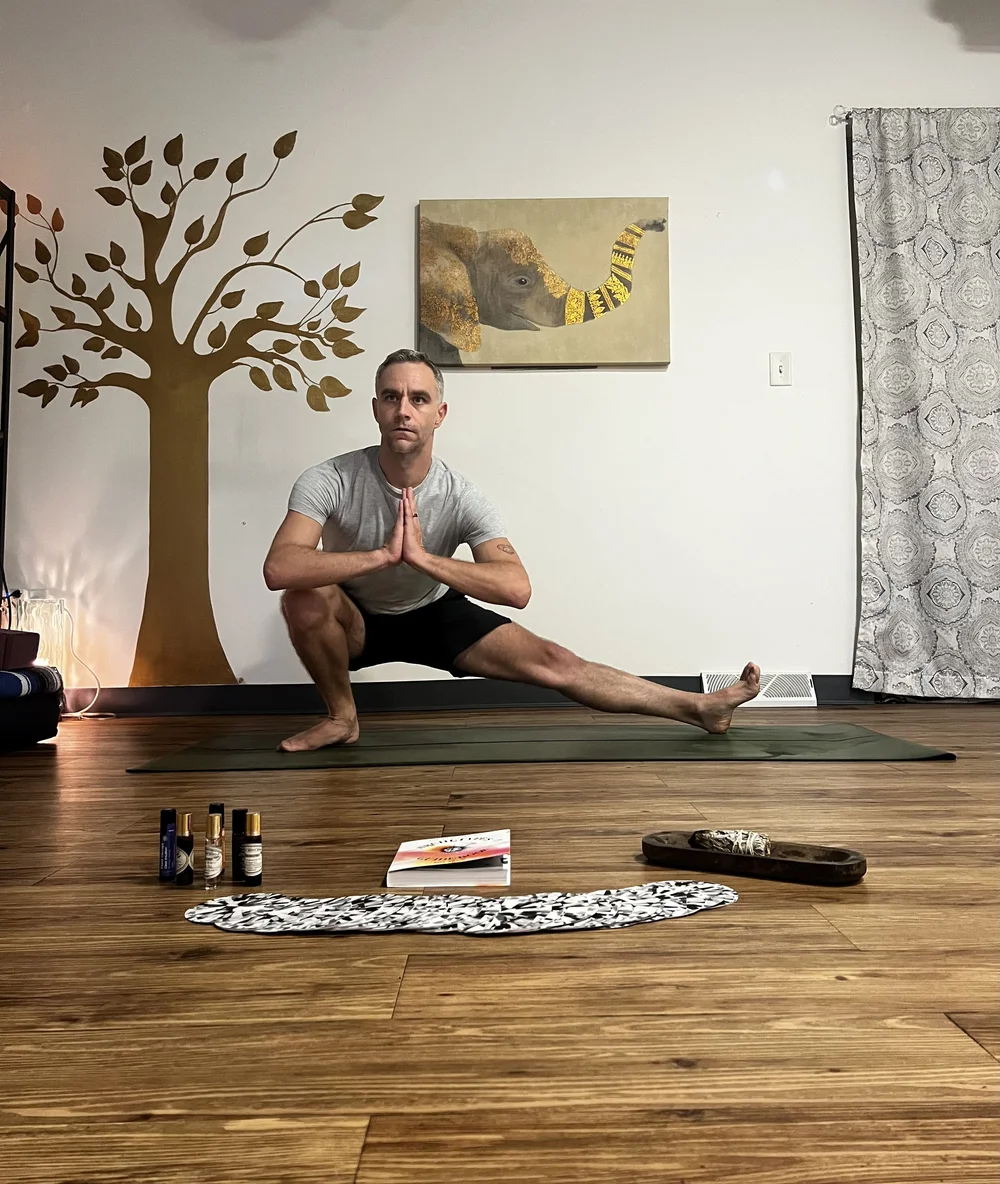
The Gratitude Cup is the seated practice I teach in class. Come do it with other people in the room.
Anchored Flow Wednesdays · 6:30 PM New Lenox
Anchored Flow is my weekly class at Yoga Face and Body Spa in New Lenox. For private sessions, start with a fifteen-minute call.
Rob Grigsby · RYT-200 · NeuroSomatic Intelligence practitioner