The Merry Nervous System
Calm
& bright.
Eight holiday practices for your nervous system: give, breathe, ask, experiment, plan, name it, protect your heart and gather.
Each one is three steps, a few prompts, the research behind it and one rule. Four have a guided voice mode. None takes more than ten minutes. All eight are open. No email, no lock.
Before you start: one slow breath in, a longer one out. That is half of the Doorway Reset, and you just did it.
Twenty-five small doses.
An Advent calendar for your nervous system. Each door holds one thing to do in a minute or two and the study behind it. A door opens on its date and stays open.
December 1 to 25 · one door a dayThe Advent Calendar
Your opened doors are remembered in this browser only. The studies are summarized in a sentence each; the fine print for every one is on the research page.
Eight presents. All for you.
Each present is one practice, tagged for the moment it was made for. Pick one to unwrap it. The lights on the tree come on at sunset, wherever you are.
The Merry Nervous System
Calm & Bright
Eight holiday practices for your nervous system: give, breathe, ask, experiment, plan, name it, protect your heart and gather. Each one is three simple steps, a few prompts, and the research behind it.
Every practice takes two to ten minutes and rests on peer-reviewed research. The rings breathe with you: four seconds in, four seconds out.
Three steps each
Read the steps once, then do them. Every practice is three moves you can remember in a crowded kitchen.
Practices with a guided button have timers and voice cues.
One rule
Each practice has one rule in the red box. If you only remember one thing, remember that.
Pick the one that fits the day you're having.
Go gently
The holidays can be heavy. These practices help a little at a time; they don't replace real support. In a crisis, call or text 988. For chest pain, call 911.
Practice 1 of 8 · Give
The Generosity Pledge
Giving feels good. Promising to give already counts.
A two-minute promise that starts the warm glow before you spend a cent.
- The reframesay it to yourself
- You're not too broke to be generous. You're one small pledge away.
- You'll need
- A quiet minute
- The one rule
- Small and sincere beats big and obligatory.
Your brain's reward system lights up when you give. In one study it started rewarding people the moment they promised to.
The practice
- 1
Picture one person
Close your eyes. Picture one person you could give to this week: family, a friend, a neighbor, a stranger. See their face.
- 2
Make the pledge
Silently or out loud: “This week I'll give ___ to ___.” Small counts: a coffee, a call, an hour of your time.
- 3
Let it land
Three slow breaths. Notice your chest, shoulders and jaw. Then write the pledge where you'll see it tomorrow.
Stuck? Try these
- Who could use a little more ease this week?
- Who showed up for me this year and never heard thanks?
- What could I give that costs time, not money?
Pick the first name that comes. Don't audition people.
Why it works
The promise alone moved the needle
Fifty adults were told they'd receive 25 Swiss francs a week for four weeks. Half pledged it to other people, half to themselves. The pledgers made more generous choices and reported bigger jumps in happiness, and the size of the pledge didn't matter. Nobody had spent anything yet. In other brain-scan studies, giving lit up the same reward system as getting paid, and giving by choice felt better than giving by force.
Park et al., Nature Communications (2017) · Harbaugh, Mayr & Burghart, Science (2007) · Moll et al., PNAS (2006)
The one rule
Small and sincere beats big and obligatory.
A twenty-dollar gift you resent does less for you than a phone call you mean. Keep the pledge small enough that you'll actually keep it.
Do this one on Giving Tuesday, then again whenever the season feels like a list of chores.
Practice 2 of 8 · Breathe
The Doorway Reset
The hardest part of the party is the first ten seconds through the door.
A few long exhales and one small smile, in the car, on the porch or in the bathroom before you walk in.
- The reframesay it to yourself
- You're not antisocial. Your nervous system just needs a runway.
- You'll need
- A car, a porch or a bathroom · two minutes
- The one rule
- Long exhale, half smile, walk in.
A long exhale is the fastest brake your body has. A small smile is a second, gentler one: your face sends signals back to your brain, not only the other way around. Thich Nhat Hanh taught it as the half smile.
The practice
- 1
Sigh it out
Stop somewhere no one needs you yet: the car, the porch, the bathroom. Breathe in through your nose, sip in a little more on top, then let it all out slowly through your mouth. Five slow rounds.
- 2
Half smile
Unclench your teeth and let the corners of your mouth lift, just a little, until you feel it at the corners of your eyes. Hold it for three more slow exhales. It doesn't have to be sincere yet.
- 3
Pick your first move
Choose who you'll greet first and one thing you'll say. Then walk in.
Stuck? Try these
- Who's the easiest person to say hi to first?
- What's one question I can ask instead of answering?
- When will I take my next breather?
Plan a mid-party breather too. The bathroom counts.
Why it works
Two small levers, both tested
In a month-long randomized study, people did five minutes a day of cyclic sighing (two inhales, one long exhale), box breathing, fast breathing, or mindfulness meditation. Breathwork, especially cyclic sighing, improved mood and slowed breathing more than meditation did.
For the smile: in 2022, labs in 19 countries ran the same experiment on 3,878 people. Copying a smile, or simply lifting the corners of the mouth, made people feel a little happier. In an earlier lab study of 170 adults, the ones holding a smile through a stressful task had lower heart rates while they recovered. Both effects are small, and no one tested them at a doorway. The two-minute version is an adaptation, not a tested treatment.
Balban et al., Cell Reports Medicine (2023) · Coles et al., Nature Human Behaviour (2022) · Kraft & Pressman, Psychological Science (2012)
The one rule
Long exhale, half smile, walk in.
The exhale is the brake. If you only remember one thing, make the out-breath longer than the in-breath before you open the door. Then let the smile walk in first.
Practice it once today so it's automatic in the driveway.
Practice 3 of 8 · Ask
The Smarter Gift
The perfect surprise is a gamble. The thing they asked for is a sure bet.
Ten minutes with your gift list that saves money, stress and guesswork.
- The reframesay it to yourself
- You're not a bad gift-giver. You've been guessing.
- You'll need
- Your gift list · ten minutes
- The one rule
- Ask, then give.
Givers think pricier and more surprising gifts land better. The people receiving them mostly don't.
The practice
- 1
Ask
Text the people on your list: “What would you actually use this year?” Wish lists aren't lazy. They're kind.
- 2
Set the number
Pick a budget per person and keep it. Price doesn't buy appreciation, so put the effort into fit.
- 3
Make it an experience
When you can, give something to do: a class, tickets, a walk together. Giving a thing? Attach an experience: the book plus coffee to talk about it.
Stuck? Try these
- “Is there anything on your list you'd love?”
- “Would you rather have a thing or a day out?”
- “What's something you keep meaning to try?”
Asking is the thoughtful part. It shows you care what they actually want.
Why it works
Price didn't buy gratitude. Asking did.
Givers assumed pricier gifts would be appreciated more; recipients' appreciation wasn't linked to price. People appreciated gifts they had asked for more, and even saw them as more thoughtful, while givers kept betting on surprises. In experiments with real gifts, experiential gifts strengthened relationships more than material ones, even when the giver wasn't there.
Flynn & Adams, J Exp Soc Psych (2009) · Gino & Flynn, J Exp Soc Psych (2011) · Chan & Mogilner, J Consumer Research (2017)
The one rule
Ask, then give.
A requested gift isn't less personal. Listening is the thought that counts. Mostly American samples, and a Korean study found price mattered more there.
Do this before you open a single shopping tab.
Practice 4 of 8 · Experiment
The $5 Experiment
Same five dollars. Two very different days.
A two-day experiment you run on yourself. Your own data decides.
- The reframesay it to yourself
- You're not selfish. You just haven't run the experiment.
- You'll need
- $10 and two days
- The one rule
- Same $5. Different direction.
Most people bet that spending on themselves will feel better. When researchers tested it, spending on someone else won, and the amount didn't matter.
The practice
- 1
Day one: spend it on someone
Spend $5 on someone else: a coffee for a coworker, a bigger tip, a small donation.
- 2
Day two: spend it on you
Spend $5 on yourself, the same kind of thing.
- 3
Rate and compare
Each night, rate your mood 1 to 10 and notice where you feel it in your body. Compare the two days.
Stuck? Try these
- Where did I feel it: chest, face, shoulders?
- Did the feeling last longer one day than the other?
- Who would I pick next time?
Try it with your kids. Toddlers in one study were happiest giving away their own treat.
Why it works
$5 worked as well as $20
Students who got $5 or $20 and were told to spend it on someone else were happier that evening than those told to spend it on themselves, and the amount didn't matter. Survey data from 136 countries show the same link between giving and happiness in rich and poor nations, and toddlers under two looked happier giving treats than getting them.
Dunn, Aknin & Norton, Science (2008) · Aknin et al., JPSP (2013) · Aknin, Hamlin & Dunn, PLOS ONE (2012)
The one rule
Same $5. Different direction.
This is a small, short-term lift, not a fix for a hard season. Keep the amount small so the only variable is direction.
Start today. Compare on night two.
Practice 5 of 8 · Plan
The Merry Audit
Your calendar is full. Is your holiday?
Ten minutes to protect what makes the season good, and shrink what doesn't.
- The reframesay it to yourself
- You're not bad at holidays. You're overbooked.
- You'll need
- Your calendar · ten minutes
- The one rule
- Protect the people and the meaning.
The parts of Christmas that predicted a happier holiday weren't the purchases. They were people, meaning and small traditions.
The practice
- 1
Star what matters
List every plan. Star the ones built around people you love or things that mean something to you.
- 2
Shrink one thing
Cut, shorten or simplify one plan that's only about stuff or obligation.
- 3
Make one ritual
Pick one small ritual and do it the same way every time: light a candle, take three breaths, then eat.
Stuck? Try these
- Which plan would I miss if it vanished?
- Which plan am I doing only because we always have?
- What tradition do my kids actually remember?
Small rituals count. The candle doesn't need to be fancy.
Why it works
Family and meaning beat spending
In a survey of 117 adults after Christmas, family time and spiritual experiences went with a merrier holiday, while spending money and receiving gifts went with lower well-being. In a national survey, most people said an experience made them happier than a thing. And in four experiments, a short ritual before eating made chocolate, lemonade and even carrots taste better; random gestures didn't.
Kasser & Sheldon, J Happiness Studies (2002) · Van Boven & Gilovich, JPSP (2003) · Vohs et al., Psychological Science (2013)
The one rule
Protect the people and the meaning.
One small survey and lab snack tasks, so hold it lightly. But you don't need a study to know which plans drain you.
Do this before December fills up.
Practice 6 of 8 · Name it
Name It to Tame It
Someone said the thing again. Here's what to do in the next two minutes.
A two-minute reset for after a tense conversation, before you say something you'll regret.
- The reframesay it to yourself
- You're not overreacting. Your threat system is doing its job. Give it a word.
- You'll need
- A door you can step out of · two minutes
- The one rule
- Name it before you answer it.
Putting a feeling into one plain word quiets the brain's alarm a little. It's the opposite of pretending you're fine.
The practice
- 1
Step out
Excuse yourself: refill a drink, check on the kids, use the bathroom. Space first.
- 2
Name it in one word
Silently or on your phone's notes: “angry,” “dismissed,” “tired,” “hurt.” One word, no story.
- 3
Exhale and choose
Two long exhales. Then choose: go back in, take a walk, or leave early. All three are allowed.
Stuck? Try these
- What's the one word for this?
- What do I need in the next ten minutes?
- Is this a conversation for today, or for January?
If you feel unsafe, leave. That's the right choice, not a failure.
Why it works
Words turn down the alarm
In a brain-imaging study of 30 people, labeling the emotion in an angry or fearful face reduced the response of the amygdala, the brain's alarm center, more than other ways of processing the same picture. The lead researcher called the effect likely modest. It's a first step that buys you a few seconds, not a solution to a family conflict.
Lieberman et al., Psychological Science (2007) · Balban et al., Cell Reports Medicine (2023)
The one rule
Name it before you answer it.
Answering while you're flooded rarely goes well. Name it, breathe, then decide. Some conversations belong in January.
Remember it now. You'll need it fast.
Practice 7 of 8 · Protect
The Holiday Heart Plan
The holidays are hard on hearts. Here's what you control.
Four habits for the riskiest week of the year, plus the one rule that matters most.
- The reframesay it to yourself
- You're not being dramatic. You're being the one who plans.
- You'll need
- Five minutes before you travel or celebrate
- The one rule
- Never wait out chest pain.
Heart attacks and heart deaths rise around Christmas and New Year's. Some of that is drinking and stress. Some of it is people putting off care.
The practice
- 1
Pace the drinks
Have a glass of water between every drink. Binge drinking can knock even a healthy heart out of rhythm.
- 2
Keep the basics on schedule
Meds, sleep and a daily walk stay on schedule, even when you travel. Pack meds in your carry-on.
- 3
Know where care is
Before you arrive, know where the nearest ER is. When stress spikes, take five slow breaths with long exhales.
Stuck? Try these
- Do I have my meds for every day I'm away?
- Where's the nearest ER to where I'm staying?
- Who else at this gathering should see this?
Chest pain, pressure, or a racing, irregular heartbeat? Call 911 right away, holiday or not.
Why it works
The riskiest night of the year
Doctors named “holiday heart syndrome” in 1978 after seeing heart-rhythm problems in people without known heart disease after weekend or holiday drinking binges. In 53 million U.S. death certificates, cardiac deaths peaked on Dec. 25, Dec. 26 and Jan. 1, above the normal winter rise, and delayed care is a leading explanation. In 283,014 Swedish heart attacks, risk was highest on Christmas Eve, about 37% above normal, peaking around 10 p.m.
Ettinger et al., Am Heart J (1978) · Phillips et al., Circulation (2004) · Mohammad et al., BMJ (2018)
The one rule
Never wait out chest pain.
Don't wait until after dinner or after the holiday. Chest pain, pressure, or a racing, irregular heartbeat means call 911 now. This is education, not medical advice.
Read it before you pack.
Practice 8 of 8 · Gather
The Family Table Reset
The meal matters less than who's sitting at it.
Three minutes before the meal that change how the whole table feels.
- The reframesay it to yourself
- You're not hosting a performance. You're hosting people.
- You'll need
- The table · three minutes
- The one rule
- Eat together. Touch kindly. Stay a little longer.
Eating together builds bonds, and a loved one's hand calms the brain's threat response. A tense table needs both.
The practice
- 1
Breathe together
Before anyone eats, invite the table to take three slow breaths together. Kids can blow out an imaginary candle.
- 2
Make contact
A hand on a shoulder, a hug, hands held at grace. Only where it's welcome.
- 3
Ask one real question
Ask one person one real question and listen to the whole answer. Phones in another room until dessert.
Stuck? Try these
- “What was the best part of your year?”
- “What's something you're looking forward to?”
- “Who taught you to make this dish?”
Comment FLOW on Instagram for the Family Gathering yoga flow, made for the day itself.
Why it works
Connection is a health factor
In a UK survey of more than 2,000 adults, people who ate with others more often were happier, more trusting and had more friends to lean on. In a brain-imaging study, holding a spouse's hand quieted the threat response more than a stranger's hand or no hand. And across 148 studies of 308,849 people, stronger social relationships meant 50% higher odds of survival.
Dunbar, Adaptive Human Behavior & Physiology (2017) · Coan, Schaefer & Davidson, Psychological Science (2006) · Holt-Lunstad, Smith & Layton, PLOS Medicine (2010)
The one rule
Eat together. Touch kindly. Stay a little longer.
The surveys show links, not proof, and the hand-holding study was small. But no one ever regretted the extra half hour at the table.
Use it at your biggest meal this month.
Rather breathe in a room?
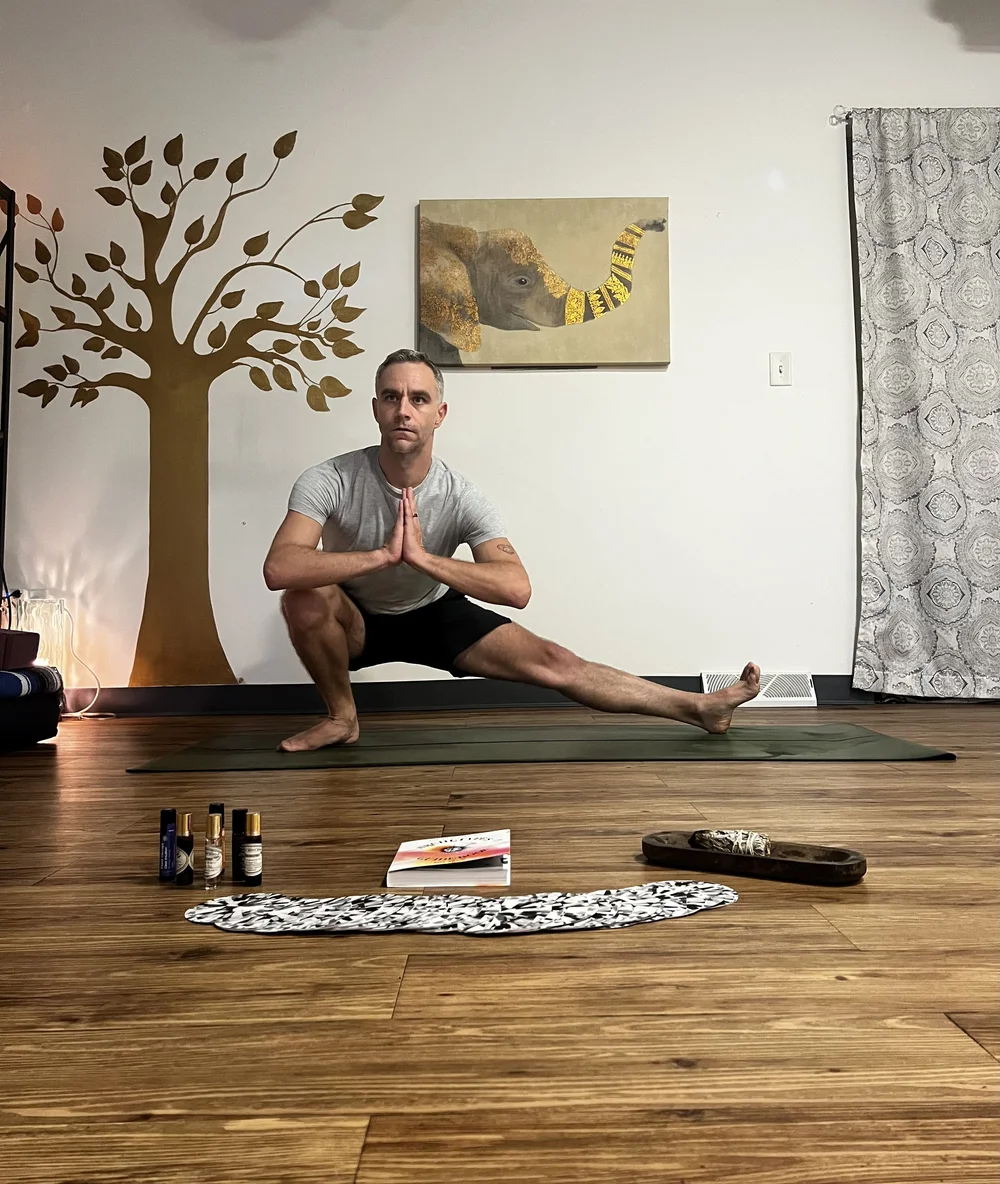
The long exhale from the Doorway Reset is how most of my classes begin. Come do it with other people in the room.
Anchored Flow Wednesdays · 6:30 PM New Lenox
Anchored Flow is my weekly class at Yoga Face and Body Spa in New Lenox. For private sessions, start with a fifteen-minute call.
Rob Grigsby · RYT-200 · NeuroSomatic Intelligence practitioner